| FEATURES
|
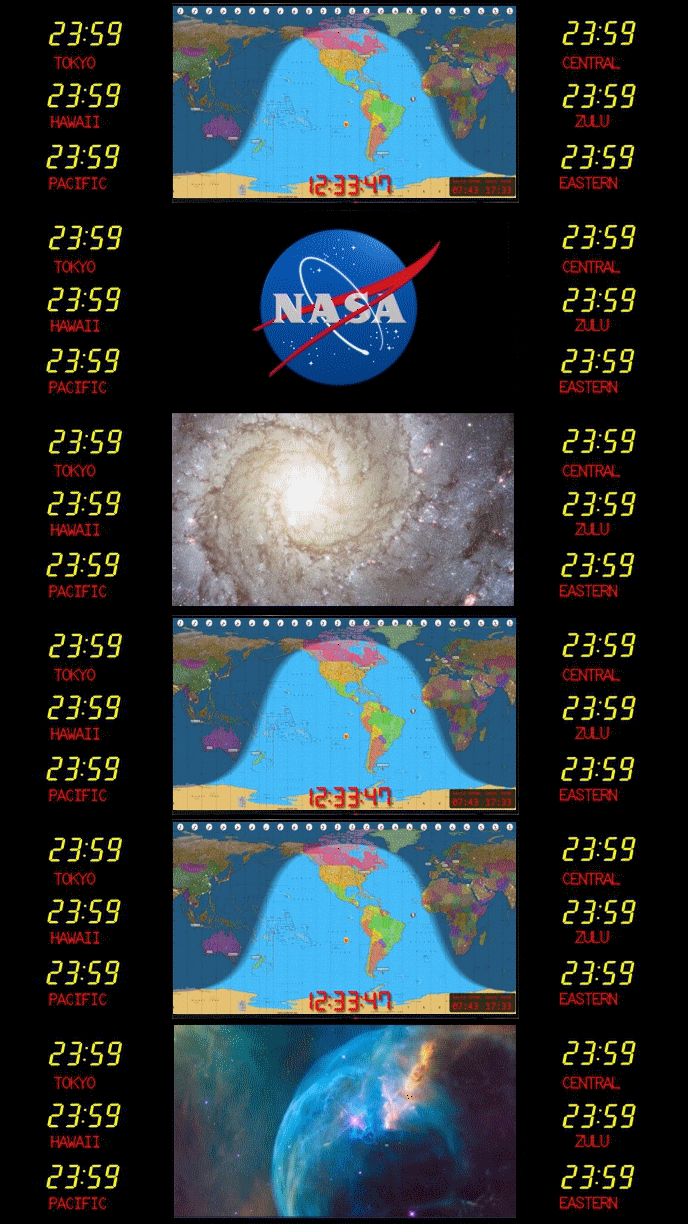
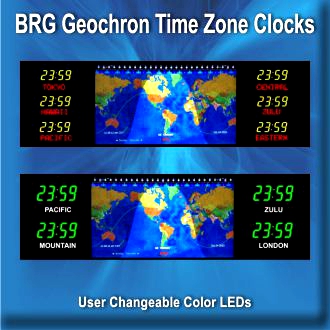
| TIME AND TIME ZONES The solid bold, often irregular, lines on the map indicate the man made legal time-zone boundaries. As the map moves slowly from left to right, time-zone arrows point to a stationary time scale across the top of the map. The 360 degree circumference of the earth is divided into 24 equal hour periods with midnight on the left, noon in the middle; and midnight again on the right. Numerals on the time scale indicate the hour. Calibrations in between represent five minute intervals. To read the time in a zone, simply follow the zone boundaries to its arrow which indicates the correct time. Some of the irregular time zones are marked with both a letter and a number. The letter indicates which arrow to read and the number specifies how many minutes are to be added to the time shown by the arrow. While standard time is the universally accepted method of telling time, the time scale on this map indicates both standard and daylight saving time. If D.S.T. is observed in the user's zone, simply make a visual shift to the top scale.
|
|
| DATE OF THE MONTH The calendar moves with the same precision as the map itself. The two markers seen in association with the words "Right of Dateline" and "Left of Dateline" indicate the prevailing date on the respective sides of the dateline.
|
|
| DAY OF THE WEEK With wall map time clock, you are instantly aware of the prevailing day of the week in any region, at any time. The area to the right of the map's international dateline is part of the passing day of the week. The area to the left of the dateline is part of the new day. The names of the prevailing days of the week appear on either side of the dateline and change automatically as each new day is born.
|
|
| SUN'S POSITION The black dot near the center of the map indicates the point on earth where the sun actually appears directly overhead at noon. This is the "apparent noon" or zenith position of the sun. "Mean Noon"— the average position of the sun over one year—is shown by the red line running vertically from the 12:00 o'clock (noon) gradation line on the time scale.
The figure 8 pattern results from the gradual shift of the sun's zenith position over the course of one year and is called the "analemma." It reflects the everchanging difference between "apparent solar time" and "mean solar time." This difference is properly referred to as the "equation of time."
|
|
WHAT MAKES THESE TIME CLOCK WALL MAPS TICKWhether it's the Original, the Standard, an Executive model or one of our Boardroom models, every single unit we make is hand-crafted in Redwood City, California, USA. Each gear is individually hand-cut to ensure optimum synchronization. Each world map is custom printed on state-of-the-art mylar film using specially-formulated inks designed to make the map resistant to ultraviolet light. And by the time each is hand-crated for shipment anywhere, it has been personally inspected, passing through 24 designated key inspection points. |
WHAT DAY IS IT, ANYWAY?Reading the date and day of the week is a snap with these wall maps. Since the map is moving from left to right, the International Dateline crosses the frame once each day. The days, date and month observed on either side of the Dateline are each displayed via indicators mounted at the map's bottom. |
WHY CONVENTIONAL CLOCKS ARE OUT OF TIME As technology continues to advance and the concept of a global economy" gains more and more acceptance, it becomes increasingly necessary to know, or at least be aware of, the time in other parts of the world. For more globally-minded people it is even more critical to know the hours of daylight throughout the world. Yet even the most advanced clocks of today are merely time indicators, devoid of any other vital information. That is, except for these clocks. |
THE DIFFERENCE IS NIGHT AND DAY.In addition to providing you the time anywhere in the world (not to mention a refresher course in geography), these wall map time clocks also communicates important, constantly-changing information not available from any other source. At one glance, they display the distribution of sunlight all over the world at any given moment. Plus, as the earth rotates and each day progresses, this sunlight distribution will update itself right before your eyes. How? Simply look at the illuminated pattern on the world map. The left edge of the pattern indicates the moment of sunrise, while the right edge indicates the moment of sunset. This sunlight distribution pattern changes perpetually, as days and seasons progress. What's more, the clock can be moved forward or backward in time. Manual controls at the bottom of the unit allow you to find out the time of sunrise and sunset in any given place and date, past or future. |
24 HOURS. 40 TIME ZONES.You probably already know how the earth is divided into 24 standard" time zones. But did you know about the 16 additional, non-standard" time zones? Don't worry. These clocks has them all covered, all year long - even during periods of daylight-saving time. What's more, the map on every single unit we make is designed to reflect changes in the world order (for example, the unification of Germany, the breakup of the former Soviet Union) |
HOW TO TELL TIME WITH THESE CLOCKS.What about those non-standard zones we just mentioned? Simple. Those non-standard and pocketed zones have boundaries that do not extend to an arrow. Instead, they're marked with a letter and a number. The letter, derived from international radio call letters, tells you which arrow of the clock to read, while the number shows you the number of minutes the region deviates from standard time. For example, the designation of India is E + 30, which means you add 30 minutes to the time you read on the E pointer. You've just completed the most difficult calculation of international time you will ever has to compute with these clocks. |